Home / Countertop Materials That Suit a Mountain Climate
Countertop Materials That Suit a Mountain Climate
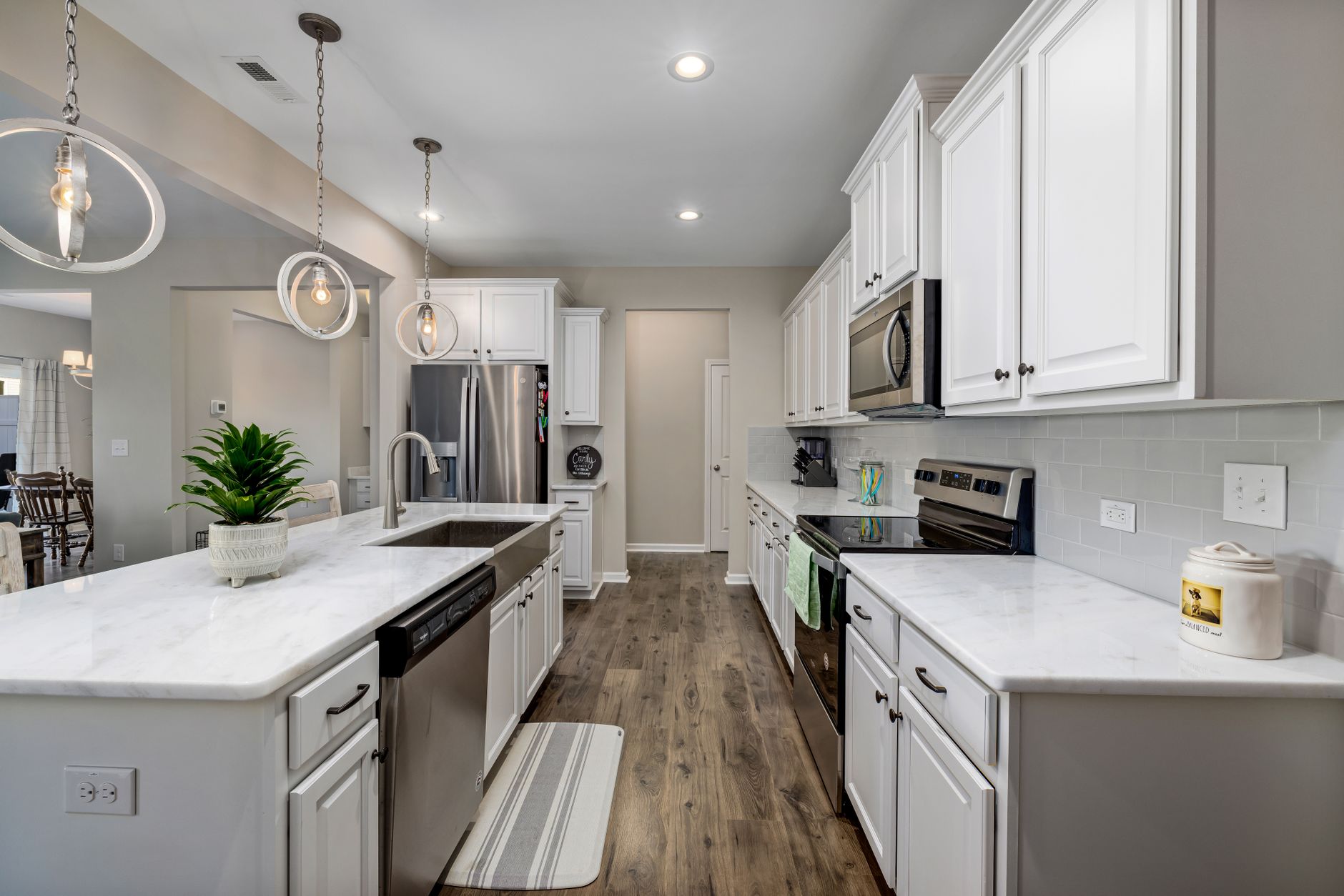
Most countertop advice is written for a generic suburban kitchen: stable temperature, central heat and air running year round, humidity somebody else worries about. Homes in the mountains around Asheville do not always work that way. Plenty run a woodstove through the winter, sit at elevations where the overnight swing is large, and spend a humid summer at the far end of a long driveway.
None of that rules out any material. It does change which trade-offs are worth making, and it changes the maintenance you are signing up for.
Temperature Swing Matters More Than Peak Heat
A kitchen that runs from a cool morning to a hot woodstove evening and back again is doing something a flat suburban kitchen does not: cycling. Materials expand and contract as they cycle, and different materials do it at different rates.
Natural stone is essentially indifferent. Granite and quartzite formed under conditions that make a kitchen look mild, and thermal cycling in a house is not going to trouble them.
Engineered quartz is different, and it is worth understanding why. Quartz counters are roughly ninety percent ground mineral bound with a polymer resin. The mineral does not care about heat. The resin does. Sustained direct heat can discolor it, and a long run of cycling near a heat source can, over years, show at a seam.
This is not an argument against quartz, which remains the most practical surface for most kitchens. It is an argument for two specific habits:
- Use a trivet, always, for anything off the stove or out of the oven
- Think about where the counter sits in relation to a woodstove or a large south facing window before you finalize the layout
Humidity and the Substrate Underneath
The counter itself is rarely what humidity damages. The cabinet box under it is.
Summer here is humid, and a kitchen that is closed up while the family is out builds up moisture. Particleboard cabinet decks swell when they take on water and never fully recover. If your cabinets are original to an older home they are probably solid wood and fine. If they were replaced in the eighties or nineties with a builder grade box, look at the deck under the sink with a flashlight before you put four hundred pounds of stone on top of them.
A good fabricator checks this during the template and tells you if something needs reinforcing. It is a small job before the stone arrives and an expensive one afterwards.
Material by Material
| Material | How it handles a mountain kitchen | What it asks of you |
|---|---|---|
| Granite | Excellent. Heat, cycling, and humidity are all non-issues | Seal every one to three years |
| Quartzite | Excellent, with a marble look | Seal, and pay more up front |
| Engineered quartz | Very good, with real heat discipline | Trivets, and keep it clear of sustained direct heat |
| Marble | Fine structurally, etches from anything acidic | Accept a patina or choose something else |
| Soapstone | Excellent. Genuinely heat proof, traditional in old mountain houses | Oil it if you want it dark, or let it go grey |
| Butcher block | Warm and repairable, but moves with humidity | Oil regularly, and expect seasonal movement |
Soapstone deserves a specific mention here because it suits the region and the housing stock. It is chemically inert, so acidic spills do nothing to it. It takes a hot pan straight off the stove with no trivet at all, which is exactly the surface you want beside a woodstove. It scratches, and the scratches sand out with fine paper and a wipe of mineral oil. In a nineteenth or early twentieth century farmhouse it looks like it was always there, because in many of them it was.
Butcher Block and Seasonal Movement
Wood is the one material that genuinely moves with the seasons here, and the movement is not a defect.
A butcher block counter takes on moisture in a humid August and gives it back in a dry, woodstove heated January. Across a long run that adds up to real dimensional change. The consequences are practical:
- Fasteners must allow the top to move. Elongated screw holes rather than tight ones.
- An undermount sink in wood needs meticulous sealing at the cutout, because that edge sees water constantly.
- Oil it on a schedule rather than when you remember. A dry block absorbs stains a fed one shrugs off.
People who like wood counters tend to like them for decades. People who want a surface that never asks anything of them should choose something else, and there is no shame in either.
The Practical Questions for a Home Outside Town
If the house is up a steep or narrow drive, mention it early. Slabs are heavy, awkward, and delivered on a truck that needs somewhere to turn around. It is far better to plan the approach in advance than to discover the problem on install morning with a crew standing in the road.
Worth confirming before install day:
- Whether the delivery vehicle can reach the house, or whether the slab has to be carried
- Where a crew can park without blocking the drive
- Whether the route into the kitchen has a tight turn a full slab cannot make
- Well water, if you have it, since hard water leaves mineral deposits that build on some honed finishes
Hard water is the one people forget. On quartz and sealed granite it wipes away. On honed marble and some limestones the deposits build and gradually dull the surface, so if you are on a well and set on a honed natural stone, ask specifically about a sealer suited to hard water and expect to reseal on a schedule rather than eventually.
A well and a long gravel drive are ordinary conditions out toward Leicester and Barnardsville rather than awkward exceptions, and between them they shape the sealing schedule and the slab delivery and installation plan far more than the choice of stone does, which is the kind of local detail asheville countertops installation corner tries to record next to the material comparisons.
Choosing Well
The short version for most kitchens in this area: granite or quartzite if you want to stop thinking about it, quartz if you want consistency and are willing to keep a trivet handy, soapstone if you have an older house and want a surface that belongs in it.
Whatever you choose, look at the actual slabs rather than a sample chip, get the cabinet deck inspected before the stone goes on, and tell the fabricator about the driveway. Those three steps solve most of what goes wrong.